
A 2026 Portland Housing Production Agenda


The new year finds Portland in an uneasy position on housing: our pipeline of new construction is drying up, our housing safety net is under attack from all sides, and covid-era population trends that have depressed prices are beginning to reverse. Governor Kotek and Mayor Wilson's slate of policy proposals will make a difference at the margin, but don't match up to the scale of the challenges our housing market is facing.
The pro-housing supermajority on Portland's city council has a lot of ambition, but no policy agenda to match. This post proposes three ideas that build on what's currently working in Portland's housing market and directly address barriers to housing production:
- Enact the "Inner Eastside for All" (IE4A) upzoning immediately
- Supercharge middle housing citywide
- Provide gap financing for stalled multifamily projects
IE4A Doesn't Need to Wait
In 2025, staff at the Bureau of Planning and Sustainability (BPS) have laid out a multi-year roadmap for studying zoning changes in the inner east side. Presentations to council have laid out multiple sub-areas to be studied individually, and the project overall looks to be following a similar process to the Residential Infill Project, where staff were able to shepherd major zoning changes through multiple elections and multiple rounds of leadership turnover at the bureau.

The cautious approach to planning has served BPS in past projects, and almost certainly helped the city weather the backlash to ADU adoption and citywide fourplex legalization. Now, it's become an impediment to a city council that almost universally supports the "Inner Eastside for All" proposal.
A rapid timeline for adopting inner eastside upzoning might look something like:
- An early-year work session to establish a consensus among city councilors about what their preferred zoning map looks like
- An ordinance directing BPS to draft a new inner eastside zoning map with guidelines reflecting the council's preference for the final map – minimum and maximum densities, and what combination of residential and mixed use zones the council would like to see.
- When the new zoning map is complete, a second ordinance adopting the changes to the relevant area plans and directing BPS to perform the community outreach required by state law.
A council-led rather than staff-led process has a number of advantages. It provides a strong signal to city staff about the new council's political priorities, and allows city councilors to directly take credit for policy changes they campaigned on. If there is backlash to the proposed changes, it will be directed at the city council rather than city staff. It also frees up staff time to focus on projects that require more technical expertise in city policy that the city council is less well equipped to address, like adopting building code changes and streamlining the permitting process.
Supercharging middle housing
In the near future, Portland will need to make some technical adjustments to our low density zoning codes to comply with new state requirements for missing middle zoning. Instead of doing the minimum to maintain compliance with state law, we should see this as an opportunity to overhaul our approach to low density zoning and copy practices from housing policy innovators in other parts of the country.
Middle housing has been a bright spot in Portland's otherwise dark housing market numbers in recent years. These smaller projects, usually four-to-ten unit townhouse developments, are less sensitive to high interest rates because they require less financing and are usually built by local developers who have less ability to shop around in different jurisdictions when rent growth is low in Portland.
While Portland's citywide fourplex legalization has absolutely worked to catalyze new developments on low density residential lots, it has a few limitations:
- Maximum building size limits, at around 1 to 1.2 FAR in most low density zones, are still a constraint on development and limit the viability of some projects
- Maximum unit counts are also relatively low; developers rarely take advantage of the density bonus allowed if they include affordable units because adding two affordable units to a four unit project is a money-losing proposition
Portland could address both issues by allowing more FAR in every residential zone, up to 1.5 citywide, and removing limitations on unit counts (this would be similar to changing all low density zones to RM2).
This would not result in a dramatic change to Portland's built environment: the "building envelope" allowed on most lots would not change, and the visual impact of a project that's slightly larger and includes a handful of extra units would likely not register for most homeowners. In places with enough demand, it would allow for the low-rise walk-up apartment buildings that have become quite common in north Portland:
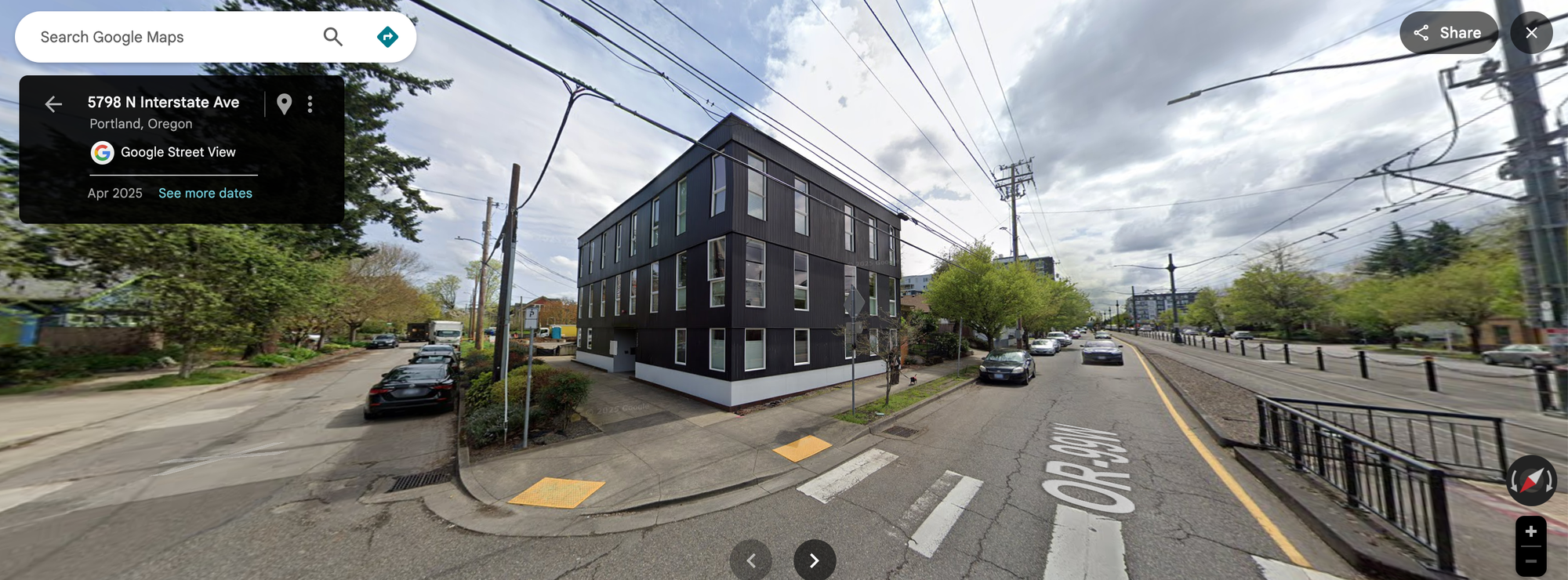
Similar to the inner eastside upzonings, this change does not need extensive study to establish its feasibility. Collaboration between council and city staff will be required to determine specific zoning code language but this is another area where the council should take the lead and establish a short timeline early on for completing the project.
This would have felt like a drastic step just a few years ago, but in recent years it's become much less radical. Medium density low-rise infill development has become the new norm in most Portland neighborhoods after fourplex legalization, with little backlash. Our west coast peers have also come a long way since we were a leader on this issue: Spokane removed their density limits in 2022, and last year saw San Francisco remove density limits and Seattle significantly increase allowed density in low-density zones. Meanwhile, nearly all of Portland's inner neighborhoods were built under a zoning regime with no limits on residential density. There's simply nothing to be scared of here.
Closing the gap for large market rate projects
Rising interest rates and falling rents have left a large number of housing developments stalled out in recent years, with projects approved by local governments but unable to make high financing costs work.
Portland should borrow from a proposal from the Center for Public Enterprise and senator Adam Schiff's Housing BOOM Act and try to resurrect some of these projects with low cost gap financing.

This type of public financing has traditionally been used only for public housing projects, most famously in Montgomery County, MD. But there's no inherent reason private developers couldn't take advantage of these types of loans, and they're a good fit for Portland's current budget situation and housing market.
Using loans rather than grants gives the city more flexibility for funding the program. We could tap investment funds like Prosper Portland's strategic investment fund, or reserves of programs like the Portland Clean Energy Fund, with the expectation that dollars lent out will eventually be returned.
Inducing new private construction would be an economic boost for the city and help buoy construction employment at a time when construction jobs are at extreme risk from declining public and private housing investment. It would help affordability not only by creating affordable units through the inclusionary housing program, but also through market effects like filtering and vacancy chains. Most importantly, it would guarantee that there will be housing units in the pipeline when population growth begins to rebound, and help the city avoid a snap-back in prices that would devastate tenants who are already struggling with current price levels.
This policy needs much more exploration than the two listed above. Councilors and their staff should investigate:
- How large of a loan and at what interest rate is required to make eligible projects pencil out?
- Are there developers with approved projects who are actually willing to participate in a new financing experiment with the city?
- How much risk is the city taking on, and what strategies could help mitigate those risks?
With those parameters established, we could start with a small tranch of loans – less than $10 million, to smaller projects that need less financing. Contingent on the success of those projects, the city could then release a larger amount of funds.
This should be framed as an emergency intervention in a housing market in crisis, similar to the system development charge (SDC) waiver. But similar to the SDC waiver, if it proves successful it doesn't have to be temporary: if the city is recovering its investment from these loans, it can continue to make them, grow the program over time, and have a valuable tool to maintain construction levels in future downturns.
Portland's political left is firmly committed to pursuing a social housing program, and this should be a good first step towards completing that promise. The largest barrier by far to social housing in Portland is funding: large-scale public housing production will require a commitment of hundreds of millions, if not billions, of dollars to social housing revolving loan funds, but currently the city of Portland's housing bond funds are fully spent while the city has a substantial budget deficit.
The immediate problem to solve for social housing then isn't actually creating a program, it's building the political case to ask voters to approve a new social housing funding source, most likely via a local option levy ballot measure. Gap financing for market rate multifamily projects gets us part of the way there: it demonstrates that the city can responsibly evaluate risk in housing developments, and develops internal staff expertise that will be required for a full social housing program.
In Conclusion
Portland's innovative urban planning (at least by US standards) is a source of civic pride for our city, but we're now falling behind. Zoning reformers in other cities have won dramatic gains in recent years, and we're entering a world where proposals that looked ambitious a few years ago are becoming table stakes for any city looking to attract housing capital. We can't solve all these problems in 2026, but we can course correct. We need to lean into what's working in our housing market, and try to directly address what isn't working. With our new city government structure, we can also move faster on more ambitious policy proposals than was possible two years ago.
We need to remember that housing underproduction is central to every problem this city is facing today: our homelessness crisis, our budget crises, and our economic challenges all have their origins in our inability to build enough infill housing in high-demand parts of this city. If we don't use every possible tool to increase housing production, it will undermine every other policy investment we make in the next year.
I don't think these three proposals are an exhaustive list of all possible options for housing production policy this year. On the other hand, the gap between ideas we can't implement in the near term ("abolish all zoning"; "create a Vienna-style social housing program") and what's currently on the table ("subsidize office to residential conversions"; "continue incrementally improving permitting timelines") leaves a lot to be desired. I hope this list can contribute to a more productive conversion about housing production policy this year.