What's next for the IBR program?
On Tuesday this week, Governors Kotek and Ferguson announced a major change to the Interstate Bridge Replacement (IBR) Program:
Washington and Oregon are officially taking a new approach to tackling a pair of aging bridges that carry Interstate 5 over the Columbia River, putting off plans for highway widening and interchange upgrades that have been moving forward for years.
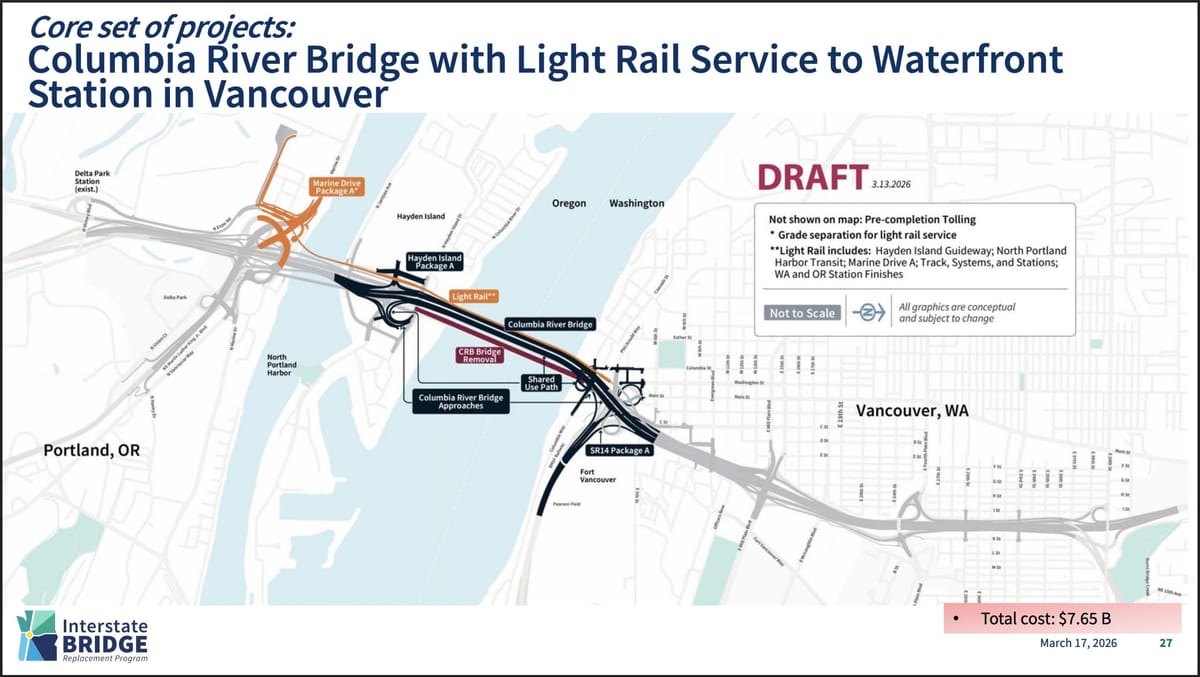
After a new $13.5 billion to $15.2 billion cost estimate for the full Interstate Bridge Replacement (IBR) was made official by project leaders Tuesday, Washington Governor Bob Ferguson announced that a "core set of projects" will become the new priority. Five miles of I-5 expansion, and seven new interchanges stretching from Portland to Vancouver, will be left to a future date, but a light rail extension between Expo Center and Downtown Vancouver remains in the plans.
Ryan Packer, The Urbanist
Reactions to the news have been mixed.
BikePortland's Jonathan Maus responded with a positive headline: "Freeway expansions value-engineered out of Interstate Bridge Replacement project, for now". Maus is correct that there's a lot to like in this announcement: the light rail and active transportation components of the bridge (love them or hate them) seem to have been preserved as a "core project," with the superfluous interchange rebuilds and highway widening moved to a second phase. "Value engineering" is not the term I'd use, since it implies those components have been totally removed, but it certainly is true that they've been deprioritized.
Not everyone agrees with that assessment, and BikePortland also published a more pessimistic take from project critic Joe Cortright: "IBR team hasn’t ‘right-sized’ the project, they’ve just hidden full commitment". Cortright makes two arguments:
- The IBR team hasn't made any substantive changes, and project phasing is a standard highway planning approach that is being used to mask the size of the project and make it more palatable to Oregon and Washington lawmakers
- The height of the bridge will require subsequent work to align the existing freeway with the new bridge height
The first point is inarguable, but the second is contested. As a couple of Bluesky and BikePortland users have commented, the changes in elevation required for the new 116 foot bridge height are all built into the first phase of the project, with the second phase of freeway expansions planned for the same height as the I-5 today:
Not buying this at all. The only interchange work the higher bridge elevation requires is at SR 14 and Hayden Island, both of which are included in the core set of projects. The tie-in to the north will be at grade as it would be if we were building the full project.
— Jonathan (@jakz92.bsky.social) 2026-03-19T19:36:05.453Z
I’m loathe to trust any of these documents, but this cross-section does seem to jive with @jakz92.bsky.social’s take? bsky.app/profile/jakz...
— Zak Remer (@kazmasaurus.bsky.social) 2026-03-20T03:45:13.671Z
Bridge height questions aside, there are other aspects of the project that will almost certainly be used to justify further expansions: the new bridge will include an additional "auxiliary lane" (a term used by traffic engineers to refer to a freeway lane that they're embarrassed about), and No More Freeways co founder Chris Smith noted on Bluesky that the full light rail extension to Vancouver will almost certainly be held hostage by the IBR team if phase two funding is in question:
Could you stop after doing SR-14? Yes. Will they? I don't think the stakeholders will stop their advocacy. Also, yesterday's Metro presentation was pretty blunt that LRT doesn't get to Evergreen until the freeway gets to Evergreen. They are currently designed as one structure.
— Chris Smith (@chrissmith.us) 2026-03-20T15:01:04.995Z
My view is that Oregon and Washington freeway fighters should see the project phasing as an opportunity, not a victory. As Cortright points out in the BikePortland Op-Ed linked above, the first phase of the project is still extraordinarily expensive and nothing has changed about the goals of the project team or the consultants they're working with. Politicians in both states have committed to a new bridge and a massive freeway expansion: until that changes, both are getting built. Just now on a 40 year timeline instead of 20 year timeline. An actual change to project commitments would require resizing the bridge, along the lines of a recent change to planned Turnpike bridge replacement in New Jersey.
With that said, phasing the project is a sign of weakness for the IBR program. The arguments from IBR opponents that the project's superfluous freeway expansions are unnecessarily driving up its cost have clearly landed with decision-makers. After a devastating short session this year, Oregon transportation advocates have a better opportunity than ever to make the case that the state's commitments to Portland-area freeway projects are damaging other priorities that voters care more about. And when the IBR team inevitably fails again to contain costs on the first phase of the bridge replacement, the second phase will likely become a much harder sell to legislators looking for low-hanging fruit to cut from the state's budget.
It's hard to predict what comes next, and Oregon transportation advocates should be particularly concerned that even a half-sized IBR is a big enough project to eat the state's transportation budget. The fight continues, but at least we're still fighting.