Oregon's Transit Payroll Taxes are a Model for the Nation

In August this year, Governor Kotek's "Transportation Vision Working Group" heard testimony from several other states about how they fund their transportation systems and structure their state transit agencies. The presentation is worth watching in full: the working group has a lot to learn about Utah's project delivery practices, Massachusetts's integration between the MBTA and MassDOT, and Colorado's fantastic intercity bus network.
But there's one specific area where Oregon doesn't need to learn from other states: when it comes to funding transit operations, Oregon isn't a laggard. By structuring our transit funding around flat payroll taxes, we have created a transit funding system at the state and local level that outperforms transit funding schemes almost anywhere else in the US. I'm troubled by rumors I've heard that legislators are unhappy with our transit payroll taxes, and so in this post I'd like to bring some tax positivity into the conversation and introduce the argument for why our transit payroll taxes should be maintained and expanded.
Trimet's payroll tax dates back to 1969 when it was instituted as the funding mechanism for the new Tri-County Metropolitan Transit District of Oregon. The Lane County Transit District was created the following year, with its own payroll tax. In 2017, the Oregon Legislature took the program statewide and created the Oregon Statewide Transit Tax, which splits its disbursements between local transit agencies and statewide transportation projects.
Oregon's transit payroll taxes are notable first for being progressive, especially in comparison to the consumption taxes favored by other states. If we consider the possibility of replacing Trimet's payroll tax with a sales tax, we can model how people at different income levels would be impacted by the different taxes. We can see that using a payroll tax takes nearly all of the tax impact off the lowest earners in Portland, with high earners easily making up the difference despite paying an extremely modest tax rate:
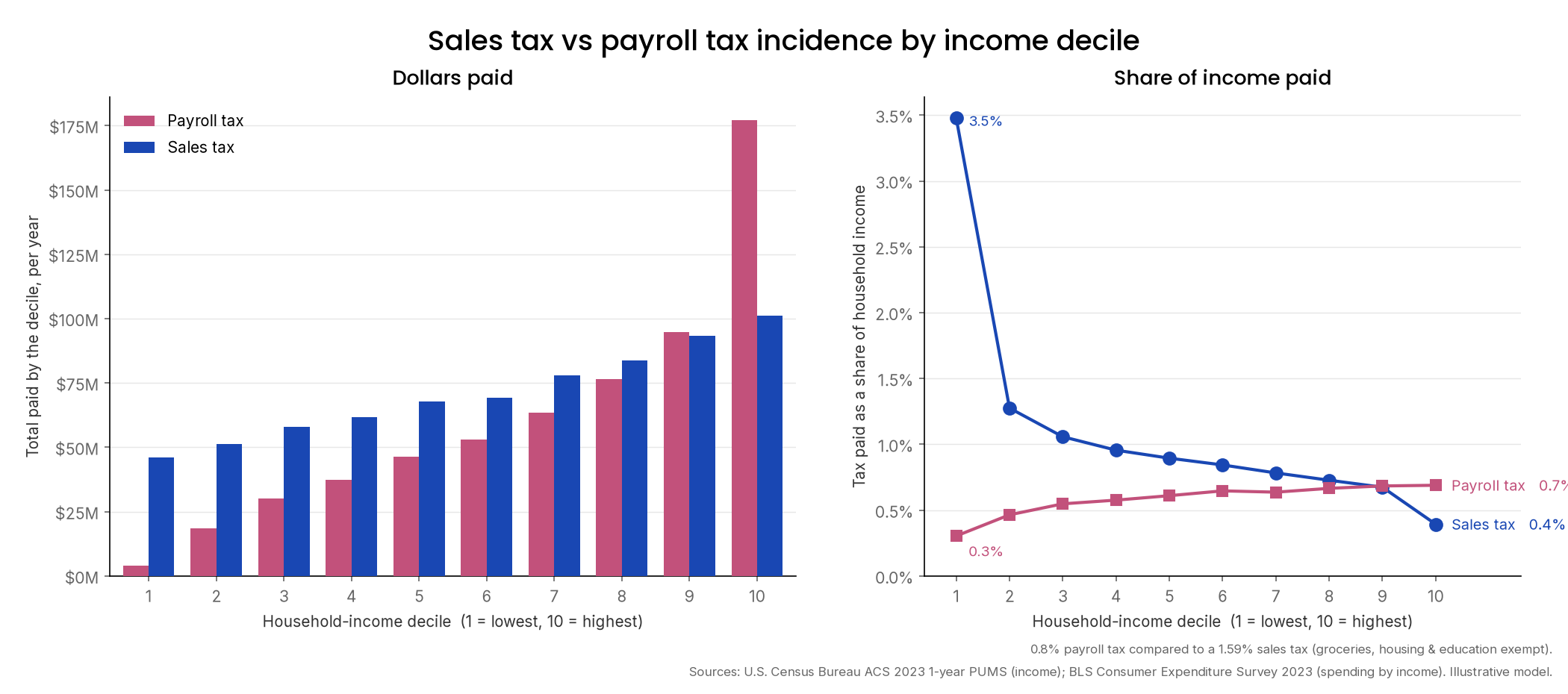
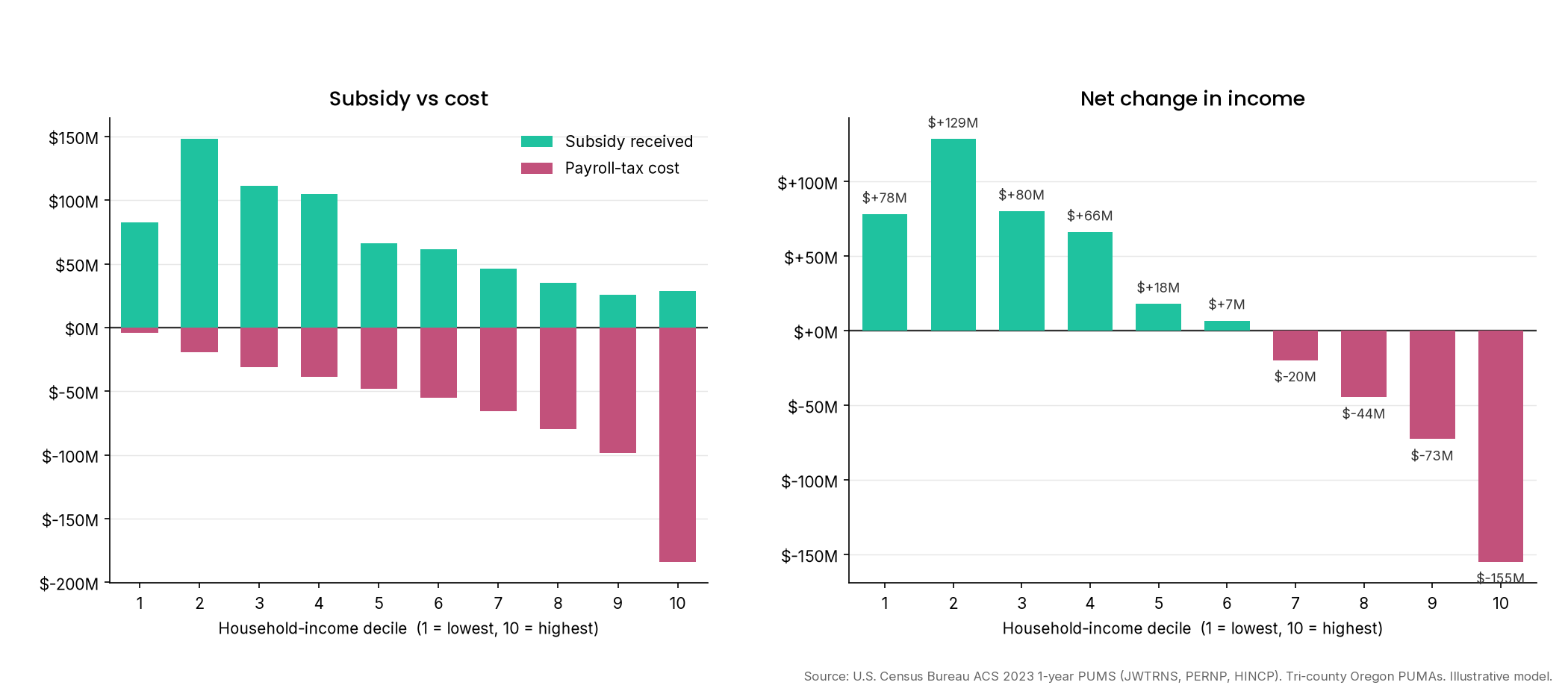
This makes the transit payroll tax strongly redistributive – low earners, who ride transit at a higher rate than high earners, accrue most of the benefit of Trimet's spending (measured by distributing Trimet's operating deficit based on transit ridership at different deciles):
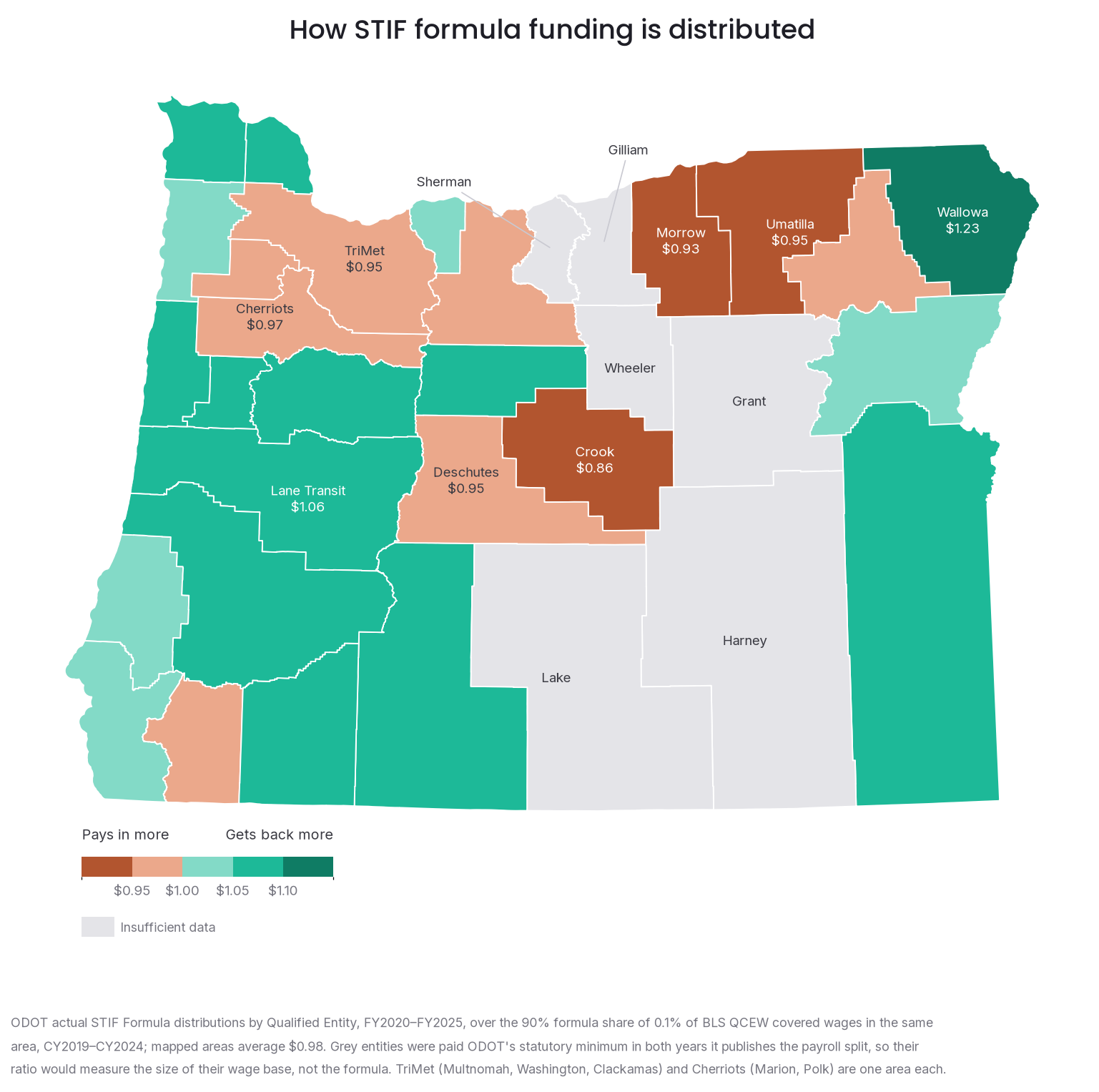
The statewide transit tax is also geographically progressive. All Oregon taxpayers pay the tax, and then funds are sent back to transit districts using two different formulas: about 90% of funds are paid out proportional to the amount of tax money the transit district contributes, and 10% of funds are distributed evenly based on population. In practice, this means that high-income districts give up a modest amount of money to support transit services for older adults and people with disabilities in lower-income, often rural communities:
Payroll taxes are also scalable: because they are progressive and broad-based, they can be raised without disproportionately burdening low earners and they bring in vast sums of money even at very low rates. An example of a system outside the US that has scaled transit payroll taxes far beyond Oregon's taxes is France's versement mobilité (VM) tax, which also dates back to 1970s transit funding crises and is also paid on the employer side. Parisian employers pay a 2.8% VM rate, while cities outside the Île-de-France region charge between 0.55% and 1.7%. In comparison, the Trimet payroll tax is set at 0.8%, while smaller cities only pay the 0.1% state payroll tax.
It's striking that the jumble of dedicated transit sales taxes that many other US jurisdictions rely on isn't common in high performing transit systems abroad. Oregon transit advocates sometimes bemoan the state's aversion to sales taxes, but a visitor from Europe might instead observe that we've solved the problem that has led other states to adopt those taxes.
Payroll tax revenue has also been remarkably stable over time, weathering the 2008 financial crisis with only a small downturn in revenues:
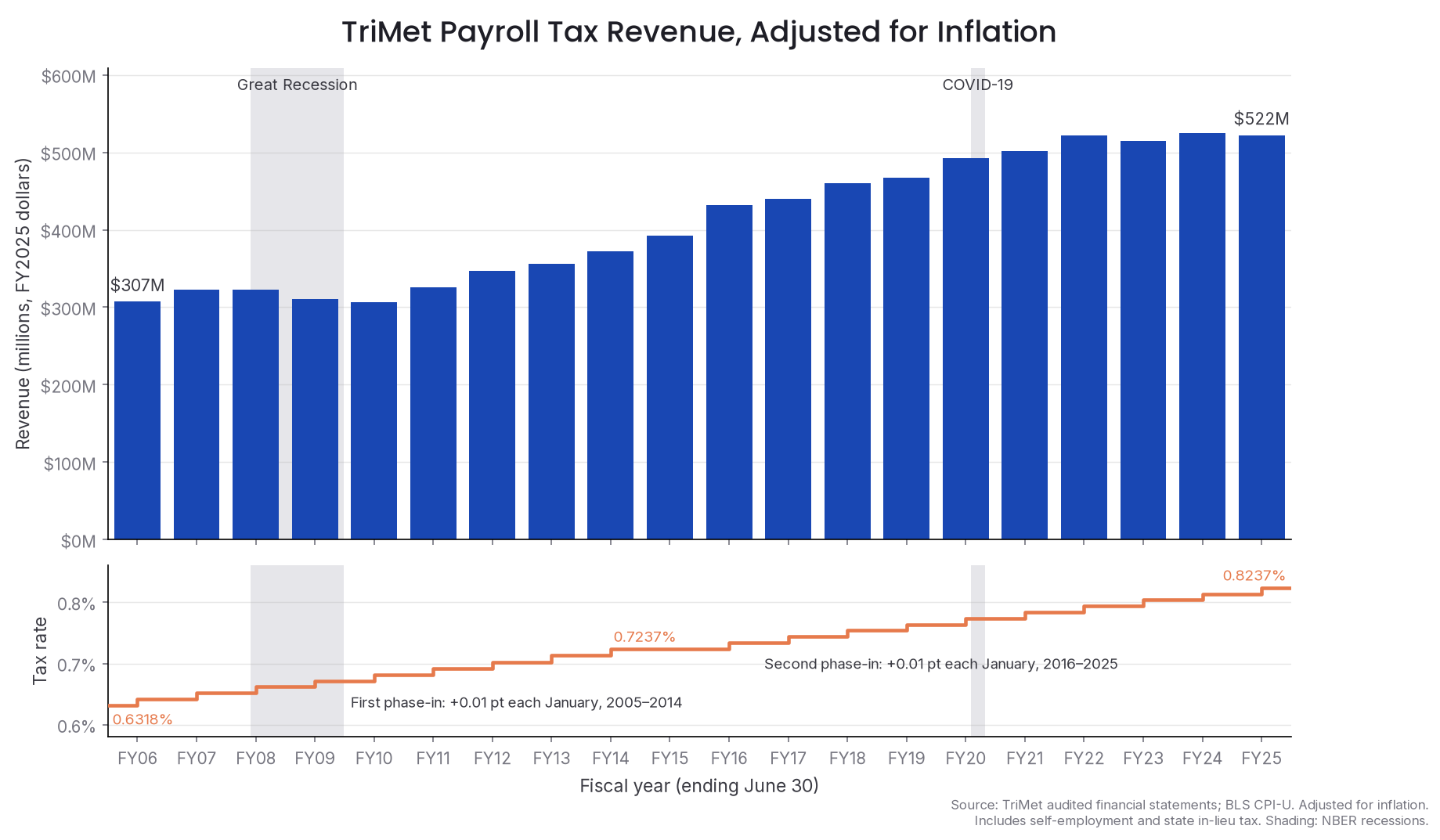
The payroll tax set Trimet up remarkably well for COVID-19 era economic turmoil as well: rising incomes among Portland-area professionals helped buoy tax revenue during the pandemic, and, unlike other Portland-area governments, Trimet has not been exposed to the effects of falling downtown Portland property values.
Oregon's local transit payroll taxes have a final important advantage relative to other funding schemes. Increases to state taxes, including the state transit payroll tax, require a 60% supermajority vote in the legislature and are subject to ballot measure recalls, like Measure 120 earlier this year which repealed the recent payroll tax increase. But precedent is clear that these limitations do not apply to increases in the tax rate of local transit districts.
ORS 267.385 states that “a district may by ordinance impose an excise tax on every employer equal to not more than eight-tenths of one percent of the wages paid with respect to the employment of individuals”. This statute limits the taxing authority of another agency but does not establish a tax rate directly; Oregon's constitution requires a supermajority specifically for "bills for raising revenue" which is a term of art in constitutional law. As the Oregon Supreme Court recently ruled:
“[B]ills for raising revenue” has been understood to mean “ ‘bills to levy taxes, in the strict sense of the words, and has not been understood to extend to bills for other purposes, which may incidentally create revenue.’ ”
And indeed, if we look at previous transit district payroll tax increases we can see clear precedent that they are exempt from the supermajority requirement – most recently, SB 34 in 2009 raised the payroll tax limit from 0.7% to 0.8% and passed the House with a narrow 32-28 majority.
None of this is to say Oregon can't learn anything from other systems about transit funding. Looking at France, it seems clear that our payroll tax rates are too low. New York, which has the nation's other transit payroll tax, has lower tax rates for smaller businesses rather than a flat tax. Internationally, it's also quite common to fund transit out of the general fund without using a dedicated tax at all, avoiding the tax fragmentation that plagues so many US systems. But in all of these cases, we would be embracing the strengths of the transit payroll tax rather than running away from them.
Hopefully legislators and advocates will keep this in mind next year. We need significant, structural reforms to our road system, where costs and revenue are out of balance and the gas taxes we have now won't survive the transition to electric vehicles. But when it comes to transit funding, we're in a different situation. The tools we have now are sufficient and will continue to work well into the future. There's no structural reform required: we just need to equalize costs and revenue while we work on other structural changes that are required to make our transit systems work. Payroll taxes are worth defending.